.svg)
Standardize your entire SDLC with spec-driven AI agents
Transform your enterprise SDLC capacity. Build secure, compliant, production-ready applications with consistent output from every developer.

How to govern AI-assisted enterprise development?
Swifter built a team of spec-driven AI agents. Each agent works from structured specifications, not individual prompts.
Agents produce editable, traceable, and production-ready output. Same quality regardless of which developer triggers the workflow.
Swifter closes the consistency gap by connecting requirements, architecture, code, testing, and deployment into one governed workspace.
Agents produce editable, traceable, and production-ready output. Same quality regardless of which developer triggers the workflow.
Swifter closes the consistency gap by connecting requirements, architecture, code, testing, and deployment into one governed workspace.
The Swifter-gen cycle
From business idea to production, Swifter's agentic engine standardizes how every developer engages in SDLC. Less time on handoffs. More time delivering value. The same structured workflow for every team member.
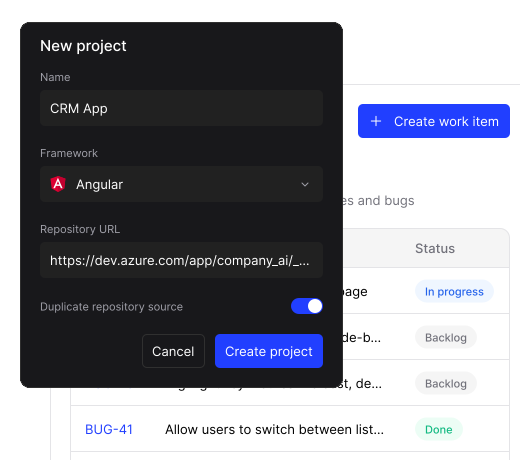
1. Analyst: From ambiguity to structured spec.
Import user stories, acceptance criteria, and supporting artifacts (like Figma designs) to generate versioned structured specifications.
Link requirements directly to Azure DevOps, Jira, and GitHub for seamless backlog integration and audit trails.
Guide your teams through structured agent-assisted workflows that refine inputs for architecture, testing, and development.
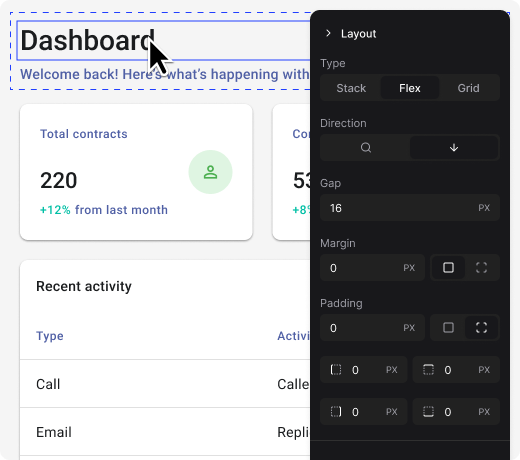
2. Design-System Engineer: From spec to compliant UI.
Generates architecture and system design docs (TDD, SDD) from structured specs.
Models data, UI, and component relationships visually and in structured formats.
Enforce design standards and reusable components for consistency and compliance.
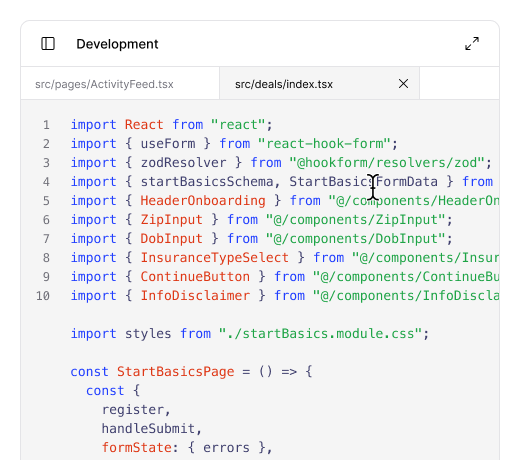
3. Developer: From spec to code you own.
Generate editable production-ready code for frontend and backend. Same conventions for every developer.
Enhance the code with your internal coding libraries.
Integrate your APIs, cloud, and CI/CD pipeline directly. No lock-in.
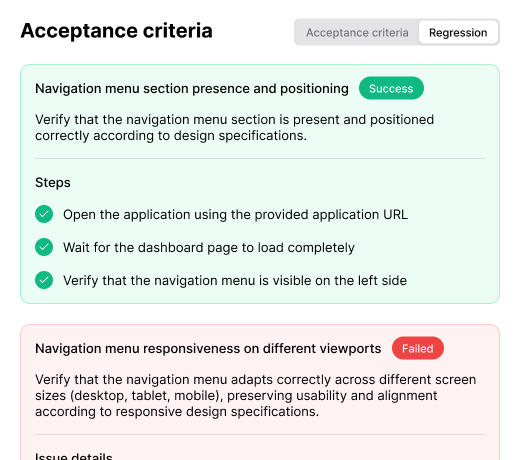
4. Tester: From spec to audit-ready tests.
Auto-generate exploratory and acceptance tests linked to the same spec as the code.
Produce traceable, audit-ready Playwright and Cypress test specs.
Integrate test coverage and remediation insights into CI/CD pipelines for automated validation.
Why spec-driven development? Why now?
Swifter's agentic engine standardizes how every developer contributes to your SDLC.

Consistent workflow integration
Every development stage is connected. Same structured workflow eliminates variation between teams and developers.

Governed business-IT collaboration
Stakeholders and development teams work in one platform. Full visibility and governance throughout the development process.

Enterprise-grade control
All outputs are editable, version-controlled, and owned by your organization. Same quality from every developer. Zero lock-in.
Replace compounding disorder with controlled delivery.
One spec. One source of truth. No drift. Swifter's AI agents deliver production-ready, auditable code from a single structured specification — so your team ships faster without compounding risk.




© 2025 Swifter.io All rights reserved.


