.svg)

.png)

.svg)
.svg)

Why Spec Driven Development Matters Now
Organizations have adopted AI assistants rapidly, but most current tools operate only at the code level. They help draft components, but they do not coordinate roles, enforce structure, or maintain alignment between business intent and technical output.
This creates four persistent problems:
- Misalignment across teams. Product defines intent, developers interpret it, QA reinterprets it again.
- Inconsistency in logic. Different agents or assistants produce divergent implementations.
- Lack of traceability. No single source of truth connects requirements to logic to code to tests.
- Fragmented AI usage. Helpful assistants, but no system that binds them into an SDLC wide process.
Spec driven development addresses these issues by shifting the unit of work from “generate some code” to “generate from a governing specification that sets the rules for every agent in the process.”
Instead of AI assistants working in isolation, spec driven systems coordinate them, ensuring every role, human or agent, works from the same authoritative blueprint.
The Spec as the SDLC’s Generation Engine
In spec driven development, the specification is not documentation or a static artifact. It is the active generation layer that drives the entire lifecycle.
The spec defines the application’s:
- Data model and field structure
- Page layout and component hierarchy
- Interaction rules and validations
- User flows and state transitions
- Acceptance criteria and expected behaviors
From this foundation, AI agents can reason about requirements before generating anything. The spec becomes the governing contract that ensures outputs across UI, logic, and testing remain consistent, even as multiple agents or developers collaborate.
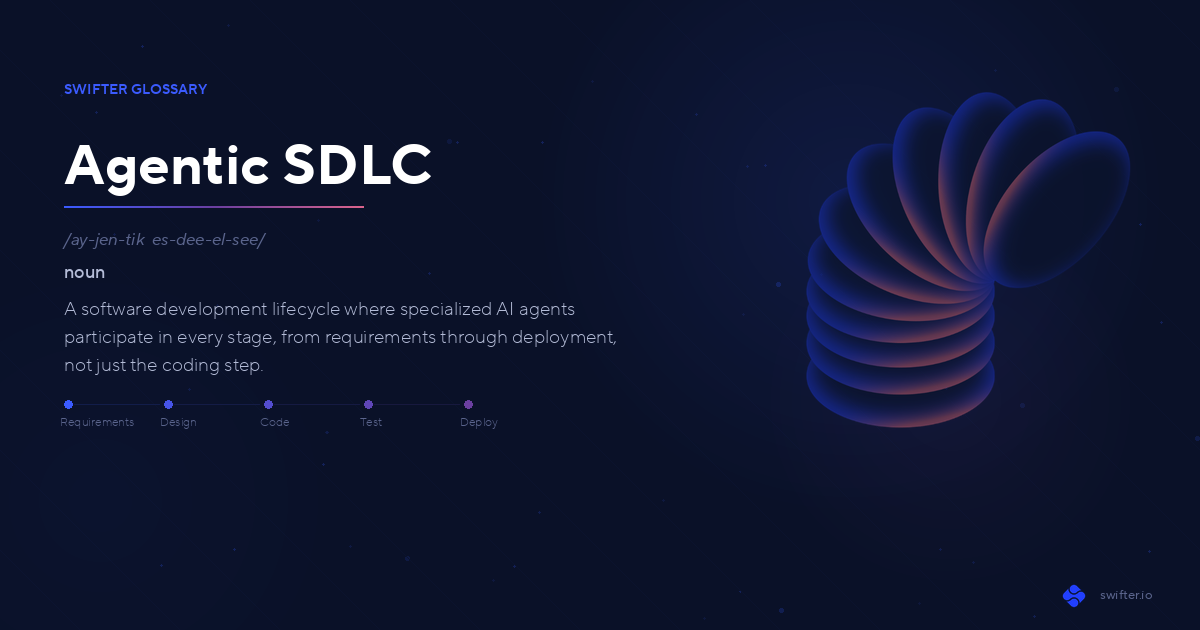
This is where the gap between coding assistants and agentic powered SDLC platforms becomes visible. Coding assistants generate code. Spec driven orchestration governs the entire delivery process.
Why Coding Assistants Alone Fall Short
Coding assistants represent real progress, but only in one dimension. They excel at:
- Suggesting code
- Completing functions
- Drafting patterns developers recognize
However, they do not:
- Govern workflows across the SDLC
- Maintain alignment between requirements and implementation
- Enforce business rules or domain logic
- Coordinate multi agent collaboration
- Track decisions, changes, or approval points
- Maintain enterprise grade traceability
In other words, they help with proficiency inside a stage, but they do not connect the stages themselves. And in enterprise environments, the SDLC is where risk, inconsistency, and regression accumulate.
Spec driven development provides the missing connective tissue. It allows AI agents to contribute reliably across requirements, design, development, integration, and testing, all governed by the same structured blueprint.
When organizations rely only on coding assistants, they get AI powered code generation.
When organizations rely on a spec driven orchestrated system, they get AI powered delivery.
How Spec Driven Development Reframes Every SDLC Role
Product and Business Roles
Their greatest pain today is translation: ensuring their intent survives the journey to code and test.
With spec driven development, the spec becomes the representation of intent, and every agent and developer uses it as the authoritative source.
Impact: clarity, consistency, fewer cycles.
Developers
Instead of rewriting misunderstood logic or filling gaps, developers operate inside a system where AI agents generate code aligned to a shared definition. Developers stay in control, reviewing, extending, and refining.
Impact: reduced rework, higher quality outputs, more time for complexity.
QA and Testing
Today, QA rebuilds its own interpretation of requirements. Under spec driven development, test logic is derived from the same specification that drives development.
Impact: complete traceability, fewer regressions, automated coverage.
Architecture and Platform Teams
Instead of enforcing standards manually, they gain a framework where structure, naming, conventions, and validations are generated consistently.
Impact: unified patterns, predictable architecture, stronger governance.
Spec driven development does not replace roles. It amplifies them by giving every role the same anchor.
.png)
Where Agentic Powered SDLC Platforms Fit In
As the industry shifts from “AI that writes code” to AI that collaborates across the SDLC, a new category is emerging:
The spec defines the application’s:
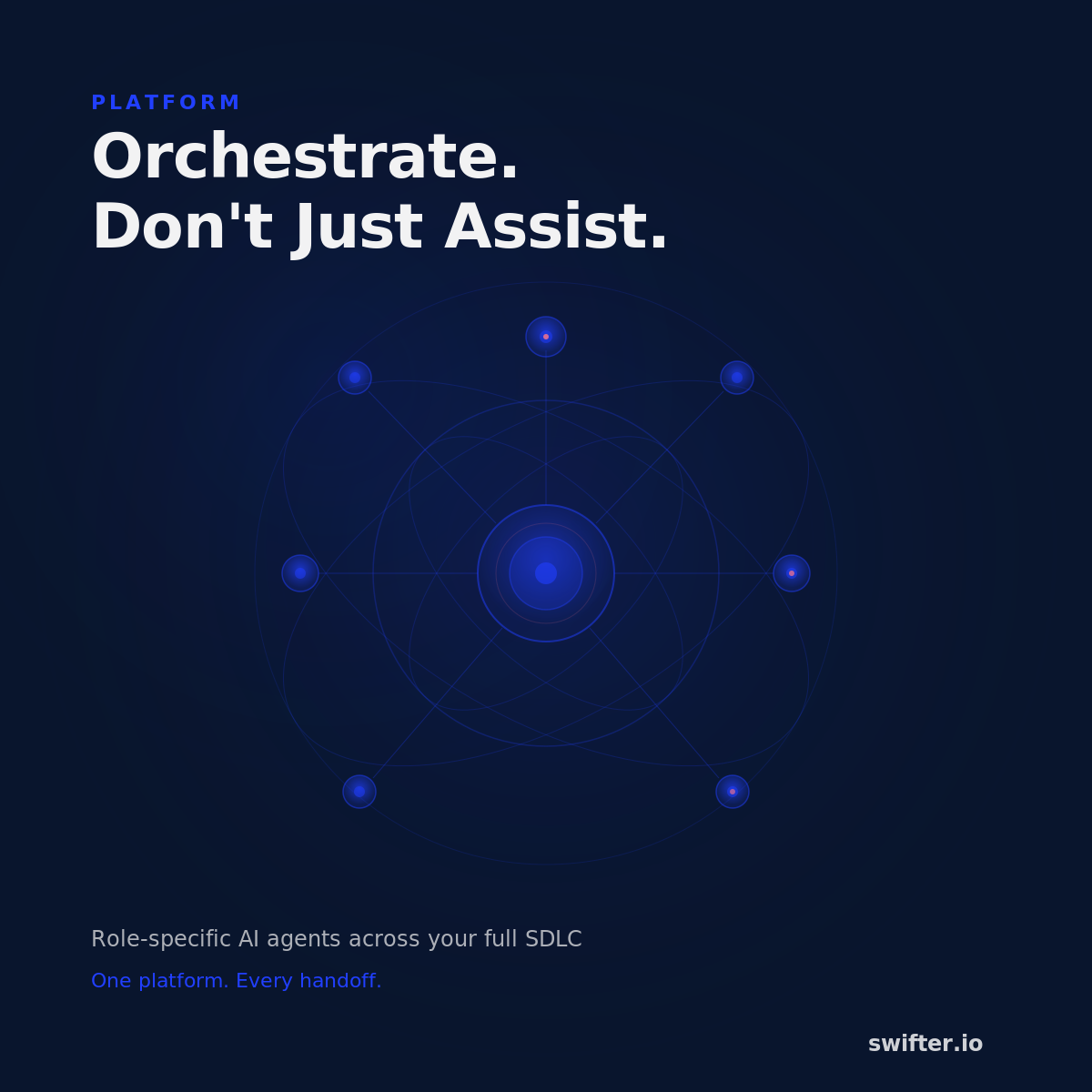
These platforms orchestrate specialized agents such as requirements, design, application modeling, development, and testing. All agents work from the same governing spec. They provide coordination, review points, approvals, traceability, and integration into enterprise systems.
Swifter is one of the more mature examples of such a platform. Its relevance lies in showing what becomes possible when spec driven development is applied inside an agentic SDLC environment:
- Multi agent collaboration is governed by a single structured spec
- Outputs remain editable, reviewable, and fully owned by the enterprise
- Human in the loop governance ensures control, not abstraction
- Every stage of delivery becomes faster because every stage stays aligned
This is the bridge from AI accelerated coding to AI accelerated delivery.
The Future:SDLC Harnesses for AI, Not Just Faster AI
Enterprises do not need faster models. They need a harness that channels model intelligence into predictable, compliant, production grade outcomes.
Spec driven development is that harness.
It transforms agentic workflows from fragmented tasks into a coordinated, governed SDLC. It ensures that when AI contributes, whether at requirements, modeling, development, or testing, it does so according to a shared and enforceable definition.
Teams relying solely on coding assistants will move faster at the edges.
Teams adopting spec driven development inside an agentic powered SDLC platform will move faster and stay aligned.
That is the competitive frontier.
In the end, the future of software delivery will not be defined by how quickly AI writes code, but by how effectively organizations harness AI across the entire SDLC. Spec driven development is the path forward.



.svg)

.svg)
.svg)


