.svg)

.png)

.svg)
.svg)

The modernization bill is already on the balance sheet.
70% of the software running the Fortune 500 was written more than 20 years ago. ~40% of enterprise IT balance sheets are now consumed by the cost of keeping that software alive. It's the silent tax on every digital transformation budget, every new product launch, every regulator response.
Every large enterprise has run the modernization math. Most have stopped halfway through, because the traditional path — rewrite, replatform, reuse — is too slow, too expensive, and too risky.
AI was supposed to fix this. Code assistants landed, translation tools launched, and the pitch was simple: feed in COBOL, get out Java. Feed in a monolith, get out microservices. It has not worked the way it was sold. Here's why - and what real AI-powered legacy modernization actually requires.
The code-translation trap
Most "AI modernization" projects today are code-translation projects in disguise. Point a general-purpose AI tool at an old codebase. Ask it to rewrite. Review the output. Ship it. The demos look great. The production results do not.
Code translation alone ignores everything that matters in a brownfield system:
- Business logic that lives outside the code. The rules for a 1998 claims engine are as much in stored procedures, scheduled jobs, and operator runbooks as they are in the source files.
- Dependencies nobody mapped. Legacy systems are rarely self-contained. They feed three downstream systems, are fed by five upstream ones, and break in ways that only show up under end-of-quarter load.
- Compliance context. A rewrite that is functionally equivalent can still be regulatorily non-equivalent if audit trails, data residency, or approval workflows change.
- The reason it was built that way. Legacy code is often a record of decisions, trade-offs, and exceptions. A "clean" rewrite that loses them re-introduces the problems they solved.
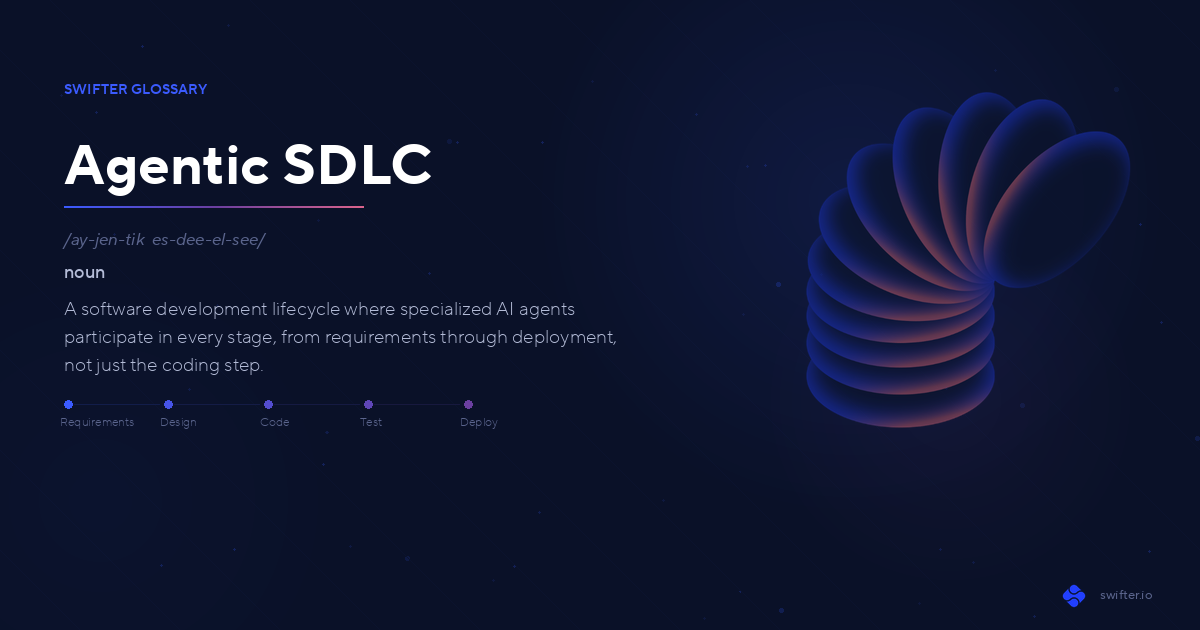
Code-only AI tools deliver around 10% productivity gains. When teams govern AI across the full SDLC — from business analysis through code, testing, and delivery — that number moves to 25–30% (Gartner, Jul 2025). Modernization is the use case where that 3x gap shows up most clearly.
What real legacy modernization needs
Modernizing a 20-year-old system with AI is not one problem. It's five, and they have to be solved together.
1. Understand the existing system in depth. Before you can rewrite a line, an AI has to read the whole estate — code, dependencies, data flows, operational history. Not a single repo. The full surface.
2. Re-derive the business specification. Most legacy systems no longer have an accurate specification. The documentation is wrong. The people who wrote it have left. AI needs to reconstruct the spec from the system itself, and confirm it with the business.
3. Design the target architecture. Modernization rarely means a line-by-line rewrite. It means a new architecture that preserves behaviour while unlocking the things the old one could not do — new channels, new data, new regulators.
4. Generate, test, and validate. Code generation is the easy part. The hard part is proving that the new system behaves identically to the old one for every material case, and better for the targeted ones.
5. Deliver under governance. Every step — analysis, spec, design, code, test, release — has to be traceable back to the business requirement and forward to the delivered change. No shadow tools. No ungoverned prompts. No surprise output.
General-purpose code assistants do step four, partially. They do not do the other four at all.
Why AI governance is the real modernization unlock
Without governance, AI-assisted modernization introduces more risk than it removes.
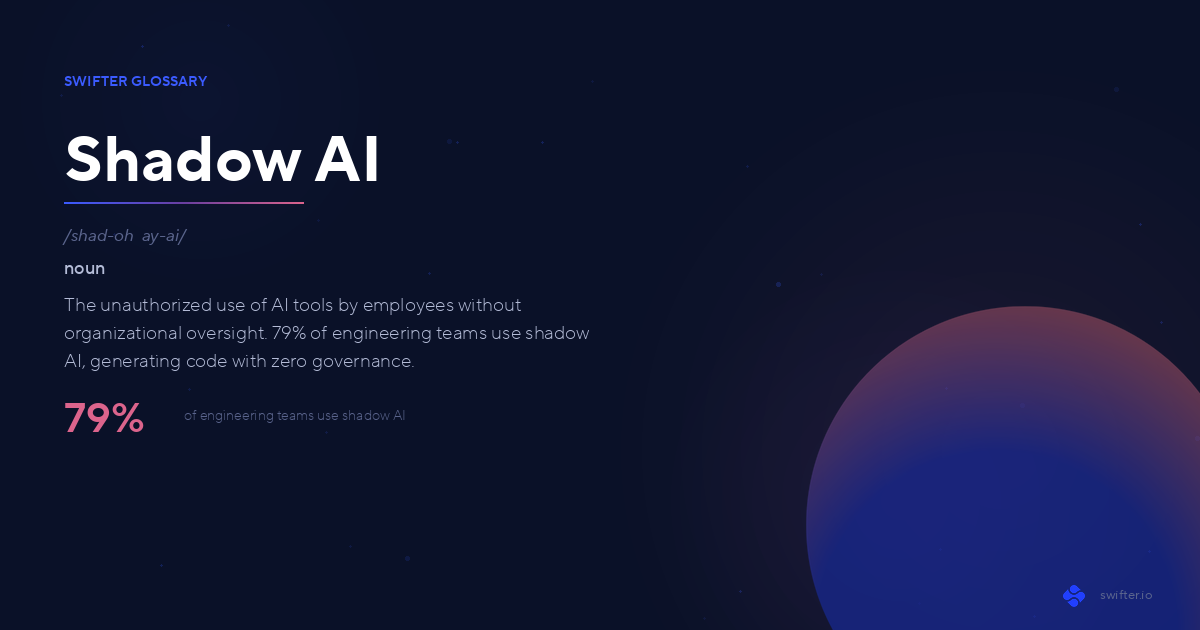
69% of CISOs suspect employees are using prohibited AI tools (Gartner, Nov 2025). 79% of engineering teams already use shadow AI (Second Talent, 2026). That is fine for prototyping. It is not fine for rewriting the policy engine.
51% of enterprises have already reported a negative incident from AI use (McKinsey, Jun 2025). 50% of AI agent deployment failures will be caused by insufficient governance (Gartner, Mar 2026). Modernization programs concentrate that risk — they are long, expensive, and touch the business's oldest, most critical code.
The governance question on a brownfield program is not "which AI are we using." It is:
- Who triggered this change?
- Which business requirement authorised it?
- Which AI agents acted on it, under what workflow?
- What evidence exists that the new behaviour matches the old?
- Can this be shown to an auditor six months from now?
If you cannot answer those five questions for every AI-assisted change, your "modernization" is just faster tech debt.
From code translation to governed agentic engineering
The shift is from code-translation thinking to full-SDLC thinking. From "what can an AI write?" to "which roles can agents play, and under which governed workflows?"
That is the Swifter model.
- Analyst Agents re-derive specifications from existing code and confirm them with the business.
- Developer Agents generate the new implementation against the spec — greenfield or brownfield — on top of the client's chosen LLM and toolchain.
- Testing Agents validate behaviour against the original system and the new spec.
- A governance layer makes every hand-off traceable, every prompt repeatable, every output auditable.
Developers keep their IDE and tools of choice. Platforms keep their existing Jira, Confluence, GitHub, and Azure DevOps. AI is not a side-channel — it is the governed spine of the program.
This is why full-SDLC AI delivers the 25–30% Gartner productivity gains that code assistants cannot. It is also why regulated industries — insurance, financial services, utilities — can modernize core systems without trading one kind of risk for another.
The takeaway
Legacy modernization is the hardest, highest-value use case in enterprise software. It is also the use case where general-purpose AI tools show their limits most clearly.
The organizations that win the next five years will not be the ones that picked the best code assistant. They will be the ones that built a governed path from business specification to delivered modernization — and ran every AI agent through it.
Anthropic builds the engine. Swifter builds the enterprise vehicle.
See how Swifter's Agentic Engine modernizes brownfield systems under full governance →



.svg)

.svg)
.svg)


