.svg)

.png)

.svg)
.svg)

The two pictures every enterprise leader is living between
A senior developer opens an AI-assisted editor, types "add rate limiting to the billing API," and ships a working change in ninety seconds. That is vibe coding. It feels magical in the demo and on a side project. It looks like the future.
Now picture five hundred developers doing the same thing across the same codebase, every day, with no shared definition of "rate limiting," no shared definition of "billing," and no shared definition of "done."
That is not the future. That is an incident report.
Every large enterprise that adopted AI coding tools in 2024 and 2025 is living inside the gap between those two pictures. The debate has crystallised this April into a label: vibe coding versus spec-driven development.
Here is the short version. At small scale, vibe coding wins on speed. At enterprise scale, it cannot win at all — because the thing it skips is the thing that makes software auditable, governable, and safe to ship.
What vibe coding actually is
"Vibe coding" describes a workflow where the human operator prompts an AI in natural language, reviews the output, and ships it. The spec is implicit — it lives in the developer's head and in the conversation history. The quality gate is taste. The artefact is code.
It is real, it is popular, and for certain problems it is spectacular. A prototype on a weekend. A script a single engineer will own forever. A marketing landing page. These are the places where vibe coding earns its reputation.
The problem is that 70% of Fortune 500 software was written more than 20 years ago (McKinsey, 2025), ~40% of enterprise IT balance sheets are consumed by tech debt (McKinsey, 2023), and the code being modernised today runs the core business. Vibe coding a claims engine or a KYC flow is not a speed story. It is a risk story.
What spec-driven development actually is
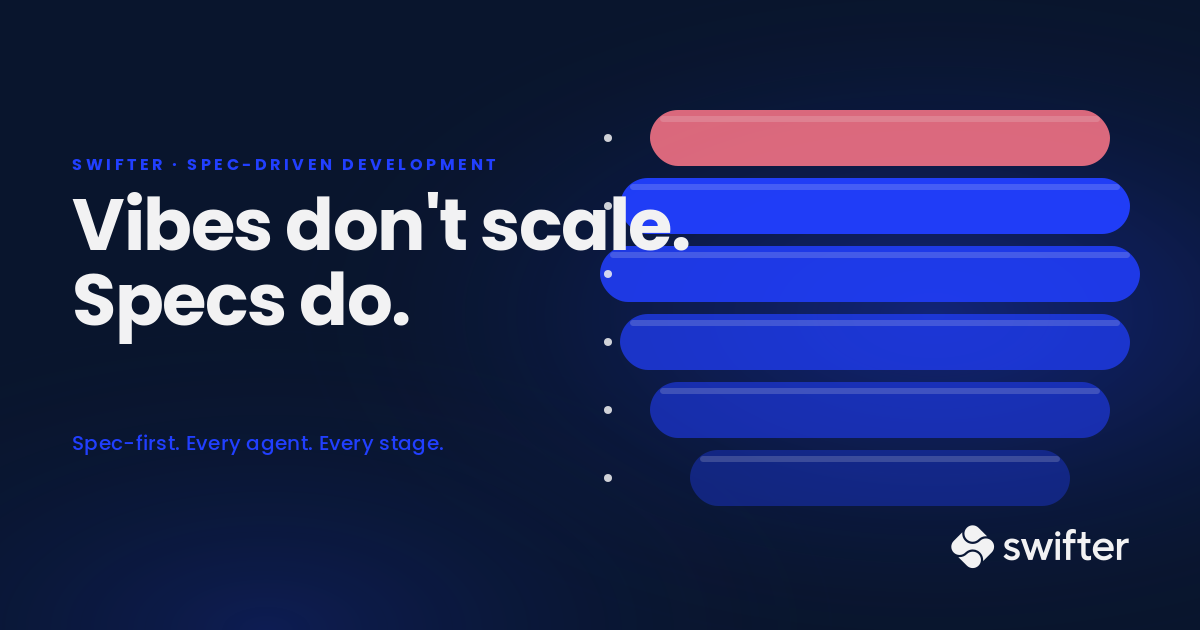
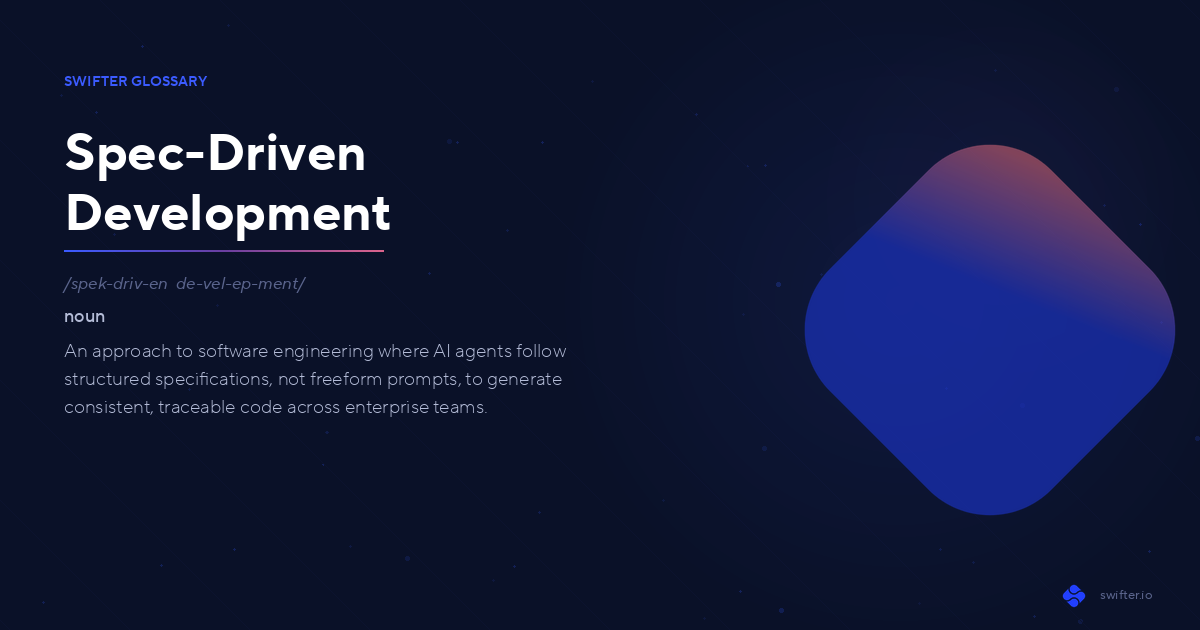
Spec-driven development (SDD) flips the workflow. Instead of starting with a prompt, the team starts with a specification — a structured description of what the system should do, who triggers it, what guardrails apply, and how success is measured. The spec is the primary artefact. Code is generated against it, tests are derived from it, and every change is traceable back to it.
In plain terms:
- Vibe coding: prompt → code → hope it matches intent
- Spec-driven: intent → spec → code and tests → traceable delivery
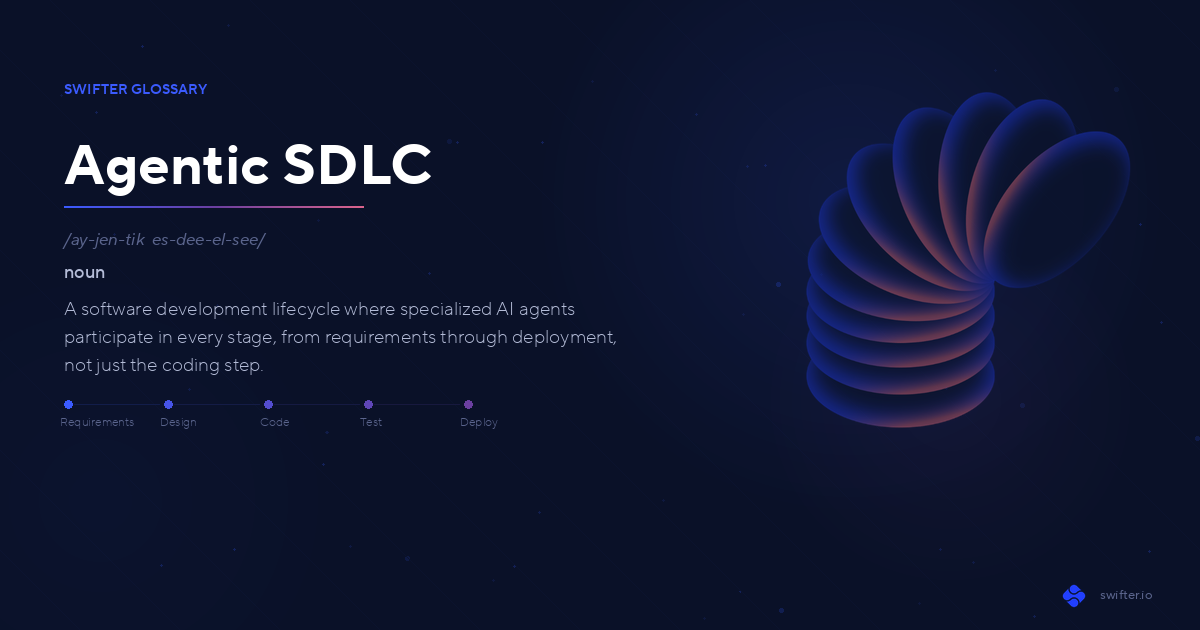
SDD has been an enterprise practice for decades in different forms. What is new in 2026 is that AI agents can finally do the heavy lifting: converting business requirements into specs, keeping code and spec in sync, generating tests directly from the spec, and flagging drift between what was asked for and what was shipped.
The 10% vs 25-30% gap
Gartner's July 2025 productivity data made the tension concrete: code-focused AI tools deliver roughly 10% productivity gains. Teams that govern AI across the full software development lifecycle — from business analysis through code, testing, and delivery — land at 25-30%.
That is a 3x multiplier. The multiplier is not in the model. It is in everything that happens before and after the model writes a line.
Vibe coding optimises the 10% step. Spec-driven development spends its time on the other 90%.
Why vibe coding breaks at enterprise scale
Enterprise software engineering has three properties that a vibe-first workflow cannot satisfy:
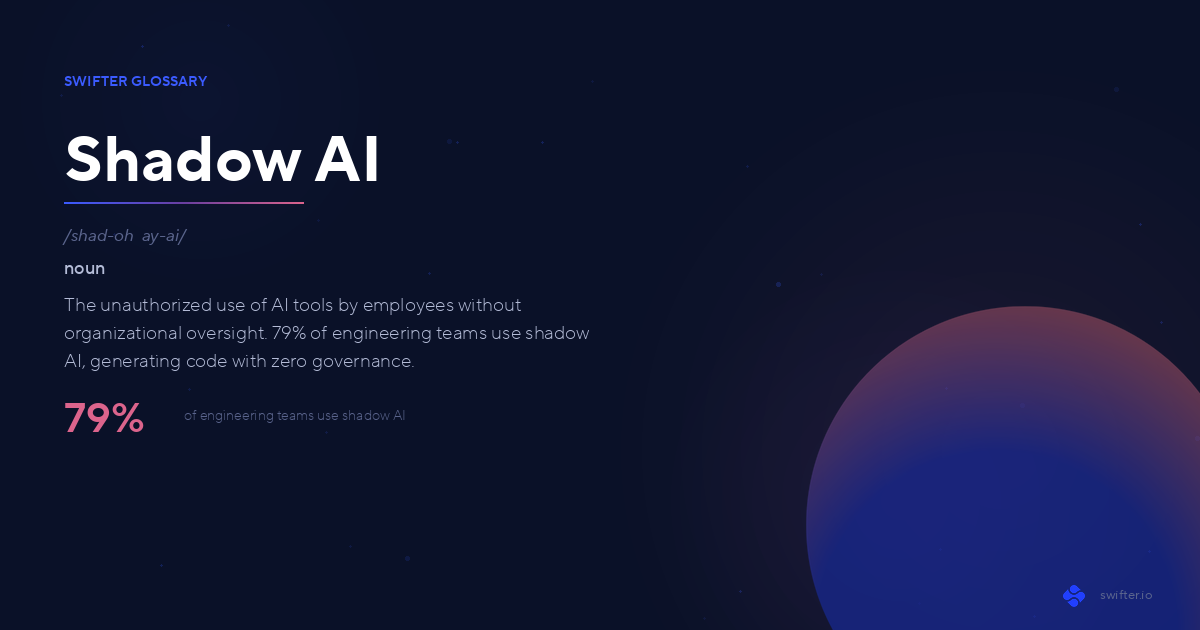
1. Consistency across hundreds of engineers. Every developer prompts differently. That is fine when two people are doing it. It is a governance failure when five hundred are. 79% of engineering teams already use shadow AI (Second Talent, 2026). Without a shared spec layer, every repo ends up with five different opinions about error handling, five different opinions about logging, five different opinions about what "authenticated" means.
2. Traceability from requirement to shipped change. Regulators, auditors, and internal risk teams increasingly want to know why a line of code exists. Which business requirement triggered it? Which version of which policy? Which approved design? Vibe-coded changes leave none of those trails. A spec-driven workflow does — every commit carries the lineage of the spec that produced it.
3. Safety on brownfield systems. Legacy code is a record of decisions and exceptions accumulated over decades. Asking a general-purpose AI tool to "clean it up" via natural-language prompts produces code that looks right and behaves wrong. 50% of AI agent failures will be caused by insufficient governance (Gartner, Mar 2026). Modernisation programmes concentrate that failure mode — because they touch the oldest, most interconnected, most business-critical code in the estate.
The governance question nobody wants to answer
Every vibe-coding enthusiast eventually runs into the same set of questions in an enterprise review:
- Who triggered this change?
- Which business requirement justifies it?
- How do we know the output matches intent?
- Who approved it?
- How do we reproduce this if something goes wrong?
- How do we ensure the next engineer asking the same question gets the same answer?
A spec is the cheapest way to answer all six questions. A vibe has no answer to any of them.
What "enterprise SDD" looks like in practice
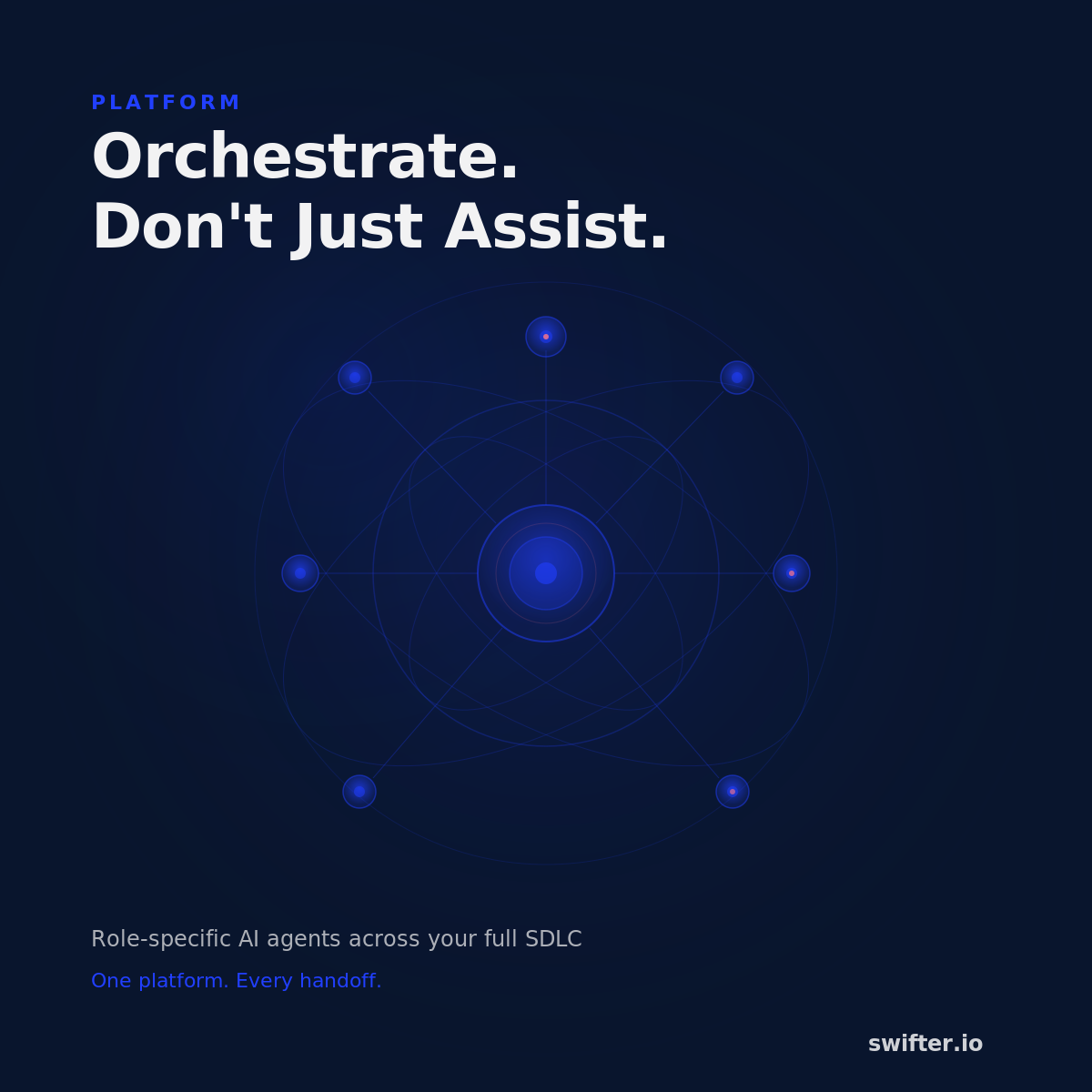
Enterprise spec-driven development is not a tool. It is an operating model where AI agents move the work from business requirement to delivered value under governance. In practice:
- A business analyst works with an Analyst Agent to convert the business requirement into a formal spec. The spec is the source of truth.
- A developer works with a Developer Agent that generates code against the spec. The developer edits, reviews, and commits — in whichever harness they already use.
- A tester works with a Testing Agent that derives tests from the spec, not from the code. A test that passes without covering a spec clause is a spec-test gap, not a passing build.
- An operations owner ships under policy. Every artefact — spec, code, test, release — is traceable end-to-end.
Each step is governed. Each step is consistent across teams. Each step produces artefacts that compound into a platform advantage.
Why brownfield is the sharpest case
The enterprise case against vibe coding is sharpest on legacy systems. Brownfield modernisation requires five things that vibe coding cannot do:
- Deep understanding of the existing codebase, its dependencies, its operational history
- Re-derivation of the business spec from a system whose documentation is wrong
- A target architecture that preserves behaviour while unlocking new capability
- Generation, test, and validation that proves behavioural equivalence
- Delivery under governance, with every change traceable
Vibe coding does the fourth partially. It does none of the other four. SDD is the operating model that does them together.
The bottom line
Vibe coding is real. It is fast. It is a legitimate tool for small problems, short-lived code, and single-owner prototypes.
Spec-driven development is what makes AI-assisted engineering work at enterprise scale — not because specs are fashionable, but because governance, consistency, and traceability are not optional when you are modernising the core of a regulated business.
The right question for an enterprise engineering leader is not "should my team use AI?" 79% of them already are. The question is: are they all using it the same way, producing consistent output, traceable back to the business requirements that triggered the work?
If the answer is yes, you have spec-driven development. If the answer is no, you have a very productive risk.
See how Swifter's Agentic Engine runs spec-driven development across the full SDLC →



.svg)

.svg)
.svg)


