.svg)

.png)

.svg)
.svg)

The Problem With Prompt-Driven Engineering
Most engineering teams adopted AI coding tools in 2024. The results were disappointing. Every developer prompts differently. Output is inconsistent. No two engineers follow the same process — even on the same team, working on the same codebase.
The underlying issue isn’t the AI. It’s the absence of a specification layer. Without a spec, AI tools amplify inconsistency at scale.
What Is Spec-Driven Development?
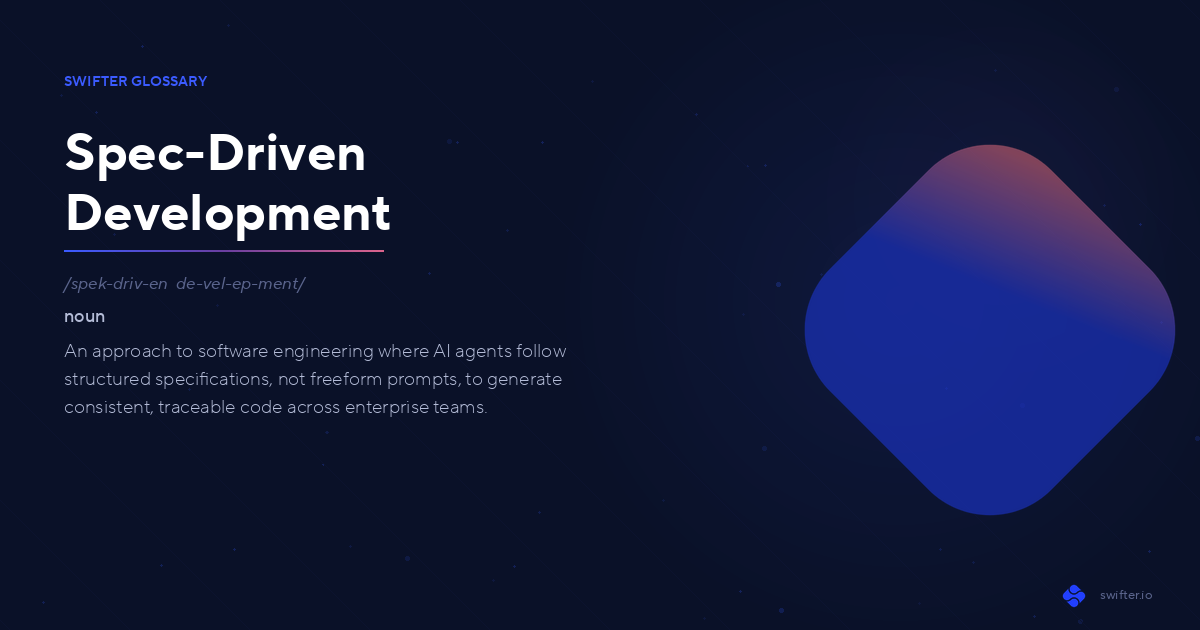
Spec-driven development is an engineering methodology where every application is defined by a structured, machine-readable specification before any code is written. The spec becomes the single source of truth — governing what gets built, how it gets tested, and what constitutes done.
In a spec-driven workflow:
- Business analysts produce structured specs from requirements
- AI agents execute against those specs — consistently, repeatably
- Every line of code traces back to a business requirement
- Reviews and approvals happen at the spec level, not the code level
Why Spec-Driven Development Is Surging Now
The timing isn’t coincidental. Enterprises now have large AI-assisted engineering teams — and zero consistency in how those teams use AI. The spec becomes the governance layer that makes AI-assisted development manageable at scale.
Gartner data confirms the productivity gap: teams using AI only at the coding step gain roughly 10%. Teams that govern AI across the full software development lifecycle gain 25–30%. The difference is structure. The difference is spec-driven development.
Spec-Driven vs. Prompt-Driven: The Key Differences
Prompt-driven development — the current default — means each developer writes custom prompts to generate code. Output varies wildly. There’s no audit trail. No way to trace a line of code to a business decision. No governance.
Spec-driven development means every AI agent in the SDLC follows a defined workflow against a structured specification. The same process runs every time, for every team, on every project. Consistent output. Full traceability. Enterprise governance built in from day one.
How Swifter Delivers Spec-Driven Development at Scale
Swifter’s Agentic Engine is built on spec-driven development principles. Instead of prompting AI tools ad hoc, every stage of the SDLC — from requirements through design, code generation, and testing — follows pre-built agentic workflows anchored to a structured application specification.
The result: 25–30% productivity gains across the full SDLC. Consistent, traceable output regardless of team size or developer experience. And governance your CTO and CISO can stand behind.
70% of Fortune 500 software is more than 20 years old. Modernizing it requires more than code assistants — it requires a methodology. Spec-driven development is that methodology.
Getting Started
The first step is separating the specification layer from the execution layer. Define what your application must do — in structured, machine-readable terms — before AI generates a single line of code. Swifter’s platform handles this from day one.



.svg)

.svg)
.svg)


