.svg)

.png)

.svg)
.svg)

Your engineering team is almost certainly using AI tools you have not approved.
The question is not whether it is happening. The data says it is. The question is whether you can see what they are doing, and whether the code they are generating meets your standards.
Definition: What is shadow AI?
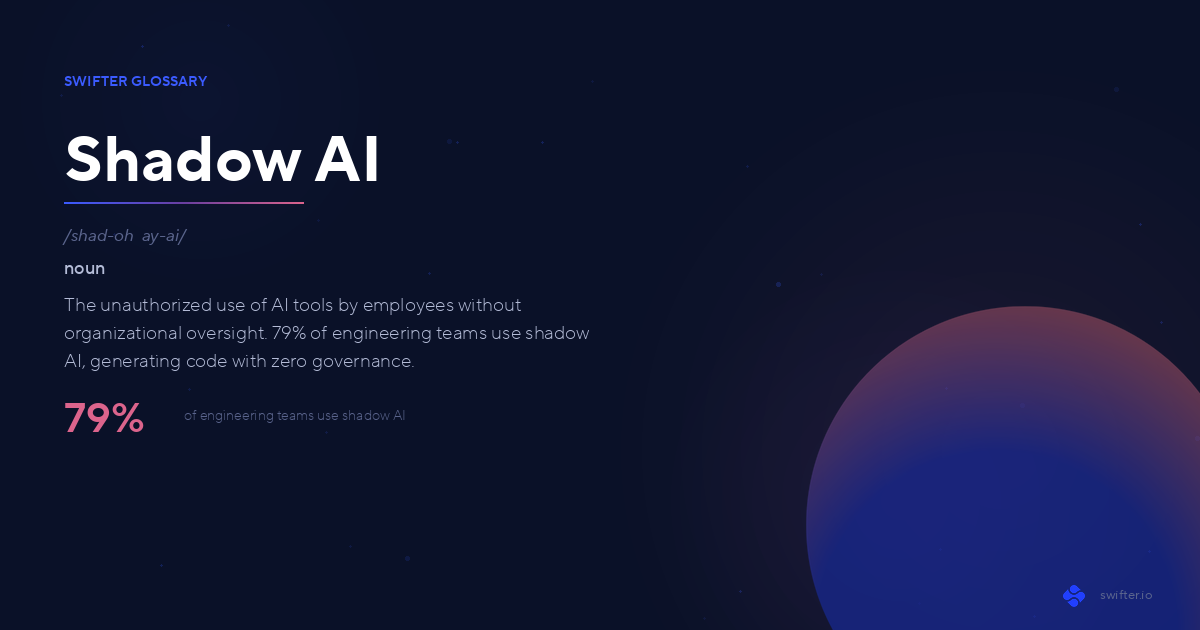
Shadow AI refers to the use of AI tools like code assistants, chatbots, and generative AI services by employees without explicit organizational approval or oversight. In software engineering, this means developers using unauthorized AI tools to write, review, or refactor code without any governance, traceability, or compliance controls.
It is the AI equivalent of shadow IT, but with higher stakes: the code these tools generate goes directly into your production systems.
The numbers are staggering
- 69% of CISOs suspect employees use prohibited AI tools (Gartner, Nov 2025)
- 79% of engineering teams specifically use shadow AI (Second Talent, 2026)
- 98% of organizations report some form of unsanctioned AI use (ISACA, 2025)
- 51% of enterprises have had a negative incident from AI use (McKinsey, Jun 2025)
What goes wrong
Samsung engineers leaked proprietary source code to ChatGPT. Amazon's agentic AI caused a 13-hour AWS outage. Amazon Retail lost 120,000 orders from ungoverned AI-assisted code changes. These are not hypotheticals. They are public incidents from major enterprises.
The risk compounds in regulated industries. When AI-generated code touches financial transactions, patient data, or insurance claims, ungoverned generation becomes a compliance liability.
The fix: govern, do not ban
The answer is not banning AI tools. Your developers will use them anyway. The answer is governing them. Swifter lets developers keep using the AI tools they prefer while enforcing enterprise-wide governance, traceability, and quality standards across the full SDLC.
Get the full picture. Download the Shadow AI whitepaper: The Productivity Illusion Inside Your AI Dev Pipeline for the complete analysis and solution framework.



.svg)

.svg)
.svg)


