.svg)

.png)

.svg)
.svg)

Every developer prompts AI differently. Spec-driven development fixes that.
If your engineering team uses AI coding tools, you have probably noticed the inconsistency. One developer writes detailed prompts. Another writes one-liners. The output varies wildly, and nobody can trace what happened or why.
Spec-driven development is the emerging answer to this problem, and it is gaining traction fast. AWS launched Kiro around it. GitHub open-sourced a Spec Kit. Martin Fowler wrote about it. Here is what it actually means.
Definition: What is spec-driven development?
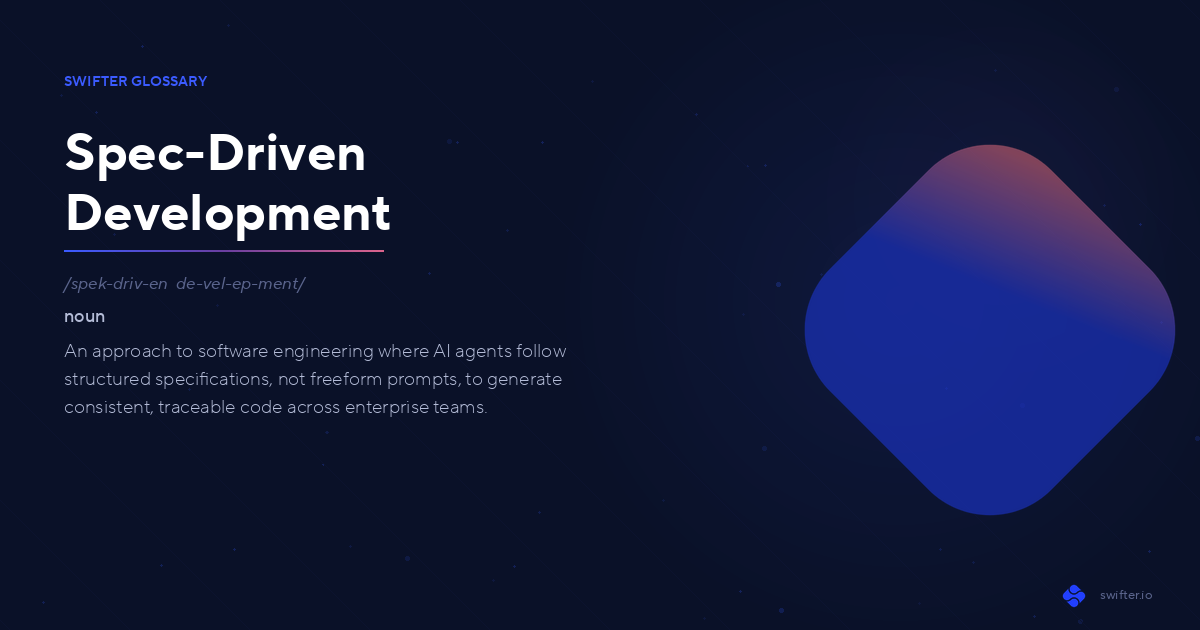
Spec-driven development is an approach to software engineering where AI agents follow structured specifications, not freeform prompts, to generate code, tests, and documentation. Instead of each developer writing their own prompts, the team defines what needs to be built in a spec, and AI agents execute against it consistently.
Think of it as the difference between asking five people to "build a login page" versus handing them all the same architectural blueprint. The spec is the blueprint.
Why it matters for enterprise teams
General-purpose AI coding tools deliver roughly 10% productivity gains. But Gartner found that teams governing AI across the full software development lifecycle see 25 to 30% gains. That is a 3x multiplier. The difference is structure. Spec-driven development provides that structure.
Without specs, you get what analysts call "prompt drift" where every developer's AI output diverges over time. With specs, AI agents produce consistent, traceable, auditable output across teams of 50 or 500 developers.
How Swifter approaches spec-driven development
Swifter's Agentic Engine is built around spec-driven development. Business analysts define requirements as specs. AI agents for analysis, development, testing, and delivery execute those specs through governed, repeatable workflows. The result is consistent output regardless of which developer triggers the process.
Unlike developer-focused tools like Kiro that help individual developers write specs, Swifter governs spec-driven development across the entire SDLC platform, from business requirements through deployment.
Ready to see spec-driven development in action? Book a demo and see how Swifter's governed workflows deliver 25 to 30% productivity gains.



.svg)

.svg)
.svg)


